The forwarding pipeline
This is the heart of ndn-rs: the path a packet takes from arriving on a face to being answered, forwarded, or dropped. If you are fixing a forwarding bug or adding a stage, read this first.
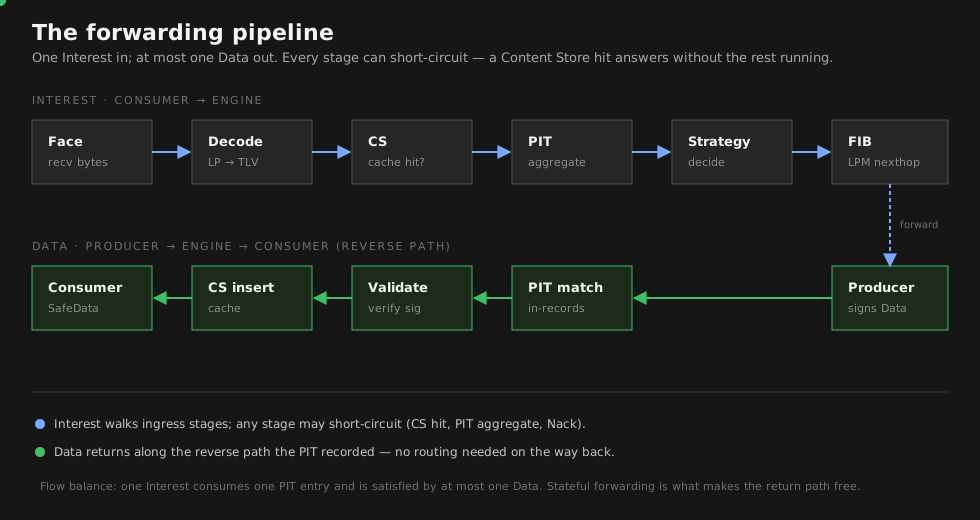
The animation shows the two halves. An Interest walks left-to-right through the ingress stages; a Data returns right-to-left along the reverse path the PIT recorded. The defining property of NDN is visible in the picture: the Data needs no routing on the way back, because forwarding is stateful — the PIT remembers who asked.
The three tables
Every NDN forwarder is organised around three tables. In ndn-rs they live in
ndn-store:
| Table | Type | What it holds | Keyed by |
|---|---|---|---|
| Content Store (CS) | ContentStore trait (LruCs, ShardedCs, FjallCs, …) | recently-seen Data, in wire form | name |
| Pending Interest Table (PIT) | Pit over DashMap | Interests awaiting Data, and the faces that want them | PitToken (name-hash + discriminator) |
| Forwarding Information Base (FIB) | Fib over a NameTrie | name prefix → next-hop faces + costs | longest-prefix match |
The CS makes any router a cache; the PIT makes the return path free; the FIB is the routing table. A per-prefix forwarding strategy decides how to use the FIB (which next-hops, when to retry, when to give up).
The ingress path (Interest)
The stages live in ndn-engine/src/stages/ and are driven in order by the
dispatcher in ndn-engine/src/dispatcher/. Reading order for the Interest
path:
- Decode — the raw bytes are parsed. If they are an NDNLPv2
LpPacket(type0x64), the link layer strips fragmentation/PitToken/Nack headers first; the inner Interest is decoded lazily (fields are only parsed when read, so a CS hit never touches fields it doesn’t need). - Content Store — if the CS holds fresh Data matching the name, it is returned immediately and no further stage runs. This is the first short-circuit.
- PIT — the Interest is looked up by
PitToken. If an entry already exists (someone else asked for this name), the new Interest is aggregated: its incoming face is added as an in-record and the Interest is not forwarded again. If it is new, an entry is created. This is where flow balance and loop detection (nonce + dead-nonce-list) happen. - Strategy — a fresh (un-aggregated) Interest is handed to the strategy
registered for its longest-matching prefix. The strategy reads the FIB entry
and returns a
ForwardingAction: forward to some faces, forward after a delay, Nack, or suppress. See Add a forwarding strategy. - Egress — chosen next-hops are LP-framed and queued to each face’s sender task.
The return path (Data)
- PIT match — the Data’s name is matched against pending entries. No match → the Data is unsolicited and (by default) dropped.
- Validate — on faces that require it, the signature is checked before the Data is allowed to propagate. This is where the security model becomes load-bearing: a router will not forward Data it cannot authenticate on a validating face.
- CS insert — admissible Data is cached (admission policy decides what is worth caching; the default admits only Data with a non-zero freshness period, matching NFD).
- Reverse forward — the Data is sent to every face recorded as an in-record on the PIT entry, then the entry is consumed. One Interest, one Data, one PIT entry — flow balance.
Why it is sharded and async, not a single-threaded core
The dispatcher runs the pipeline as tokio tasks over sharded, interior-mutable
tables (DashMap for the PIT, per-node RwLock in the FIB trie). Interest and
Data for the same name are steered to the same shard so aggregation and
matching stay correct without a global lock. A partitioned data-plane mode
(NDN-DPDK style) hashes the first name components to worker lanes for
throughput. The key invariant that keeps this safe: stages consume their
PacketContext — every stage variant except “continue” takes the context by
value, so a use-after-handoff is a compile error rather than a data race.
Where to look in the code
| You want to change… | Start in |
|---|---|
| how a stage behaves | ndn-engine/src/stages/ |
| how packets are steered to workers | ndn-engine/src/dispatcher/ |
| the tables themselves | ndn-store/src/{pit,fib,content_store}.rs |
| a forwarding decision | ndn-strategy/src/ and the cookbook |
| the sans-IO forwarding rules shared with embedded | ndn-fwd-core/src/ |
The pure forwarding rules — longest-prefix match, freshness predicates,
conformance checks — live in the no_std ndn-fwd-core crate so the native
engine and the bare-metal forwarder apply byte-identical logic. See
sans-IO and no_std.