Trust, first
In NDN you do not trust a connection — you trust the data. That sentence is easy to nod at and easy to underestimate, so this page is the mechanics: every Data packet is signed, and a rule you chose decides whether the signature actually counts.
This is the one non-negotiable. You can skip strategies, skip exotic faces, skip in-network compute — but the moment you accept a packet, you are making a trust decision, and NDN makes you make it on purpose.
A signature is not a verdict
Anyone can generate a key and sign anything with it. A valid signature only tells you the bytes were not altered since signing — it does not tell you the signer was allowed to produce this name. The real question is never “is this signed?” but “is this key permitted to sign this name?”
Treating “signed” as “trusted” is the mistake NDN is built to prevent.
Follow the chain to an anchor you pinned
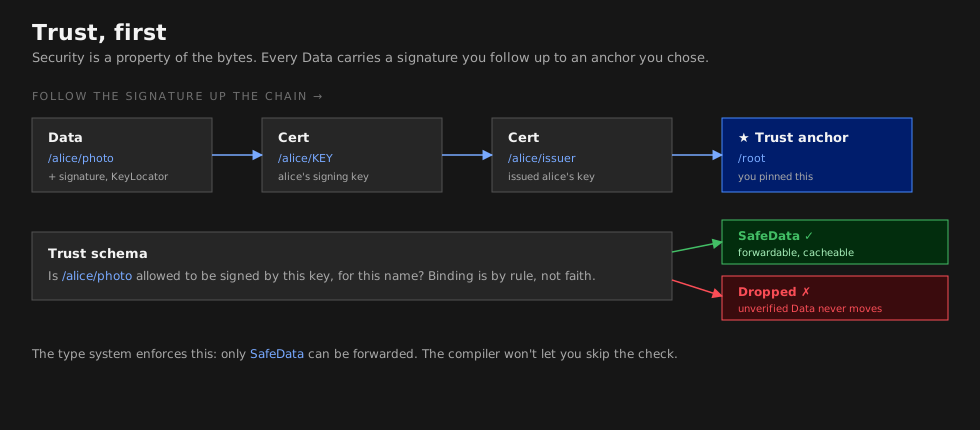
Each Data carries a KeyLocator pointing at the certificate for its signing key. That certificate was itself signed by an issuer, whose certificate was signed by another, up to a trust anchor — a key you decided to trust ahead of time. Verification walks that chain and succeeds only if it ends at an anchor you pinned.
Trust is therefore rooted in a choice you made, not in whoever happens to answer the Interest. Move the data to a different node and nothing about this changes; the chain travels with the bytes.
Names bind to keys by rule
The chain proves who signed. A trust schema decides whether that
signer was entitled to. A schema is a set of rules tying name patterns
to the keys allowed to sign them — for example, that Data under
/alice/... must be signed by a key named under /alice/KEY/.... A
signature from the wrong key is rejected even when it is cryptographically
valid, because the binding is wrong.
This is what “names bind to keys” means in practice: authority follows the namespace, by rule, not by trust-on-faith.
SafeData — the check the compiler enforces
ndn-rs makes this difficult to skip. Data that has passed verification has
its own type, SafeData, and the forwarding and caching paths accept only
SafeData. Unverified Data is not merely discouraged — it is a
different type, and the compiler will not let it onto the wire. The trust
decision is structural, not a convention you have to remember.
Choosing your policy
A trust policy answers “may this key sign this name?” ndn-rs ships several:
InsecureTrust— accepts anything. Tests only; never in deployment.StaticTrust— an explicit allowlist of keys.- schema-based trust — name-pattern rules, the usual production choice.
HierarchicalPolicy— a parent-name key may sign child-name Data.
The catalog, with the trade-offs of each, is in Trust policies. How keys, certificates, and key chains are created and stored is in Identity and keys.
Why first, and not last
In connection-based systems, security is something you add: get the bytes moving, then bolt on TLS, then audit what leaked. NDN inverts the order. Because trust rides with the data, the verification check is the precondition for a packet to move at all — there is no “insecure but working” stage to retrofit later. Deciding what you trust is step one, not a hardening pass.
Reading further
- The request this check sits at the end of: One packet, six depths, depth 6.
- Keys, certificates, key chains, signing: Identity and keys.
- The policy catalog: Trust policies.