One packet, six depths
NDN has a small number of moving parts, and the fastest way to meet all
of them is to follow a single request. We will ask for one name,
/alice/photo, and watch signed Data come back.
Read top to bottom and stop at the depth that answers your question. The first depth is the whole idea; the last is the trust check that makes it safe. You do not need all six to start building — you need depth 1.
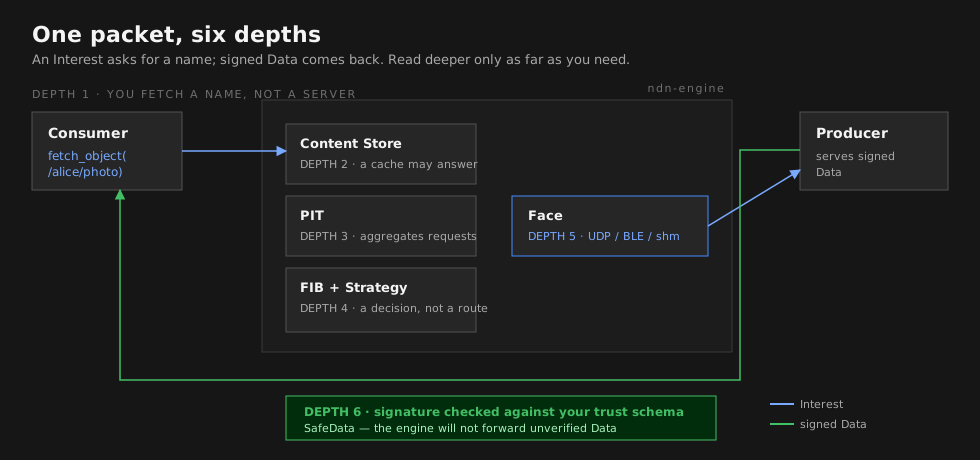
Depth 1 — You fetch a name
The consumer expresses an Interest for /alice/photo. That is the
entire request: a name. No address, no host, no open connection. Whatever
node can satisfy the name will; the consumer never learns or cares which
one did.
If you only ever read one depth, read this one. The rest is how the network makes it fast and safe.
Depth 2 — A cache may answer
The first node to see the Interest checks its Content Store — a cache
of Data it has already handled. If /alice/photo is there and still
fresh, that node returns it immediately and the request goes no further.
This is why popular names are cheap: the tenth request for the same photo is usually a local cache hit, not a round trip to the producer.
Depth 3 — Identical requests aggregate
On a cache miss, the node records the pending request in its Pending
Interest Table (PIT). If a second consumer asks for /alice/photo
while the first is still outstanding, the node does not forward it again —
it adds the new requester to the existing PIT entry. One Data comes back
and fans out to everyone waiting. Aggregation and multicast are the same
mechanism.
Depth 4 — Forwarding is a decision
To make progress the node consults its Forwarding Information Base (FIB), which lists the next hops known to lead toward the name. When more than one hop qualifies, a strategy decides: which face to use, whether to try several, when to retransmit, how to react to a failure. Routing fills in the options; the strategy chooses among them, per packet.
Depth 5 — It crosses a face
The chosen next hop is reached over a face — an NDN-layer link that could be UDP, TCP, Bluetooth, shared memory, or a browser data channel. The Interest and Data are the same regardless; only the face underneath changes. Swapping bearers does not change the packet or its security.
Depth 6 — The reply is verified
When the Data arrives, the node does not simply pass it along. It checks
the signature against a trust policy — is this key allowed to sign
this name? Only Data that passes becomes forwardable and cacheable; in
ndn-rs that verified form has its own type, SafeData, and the
forwarding path accepts nothing else. Unverified Data stops here.
How that check is rooted in keys you chose is the subject of Trust, first.
Reading further
- The same journey with every field and the forwarder state machine: Interest and Data lifecycle.
- The components as a reference, not a narrative: NDN overview.
- Why any of this is shaped the way it is: Why NDN is different.