Why NDN is different
If you have built anything for the web, you already carry a mental model of how networking works — and it is the one thing you have to set down before the rest of this wiki makes sense. This page is about that one idea. Everything else in ndn-rs is a consequence of it.
The model you already have
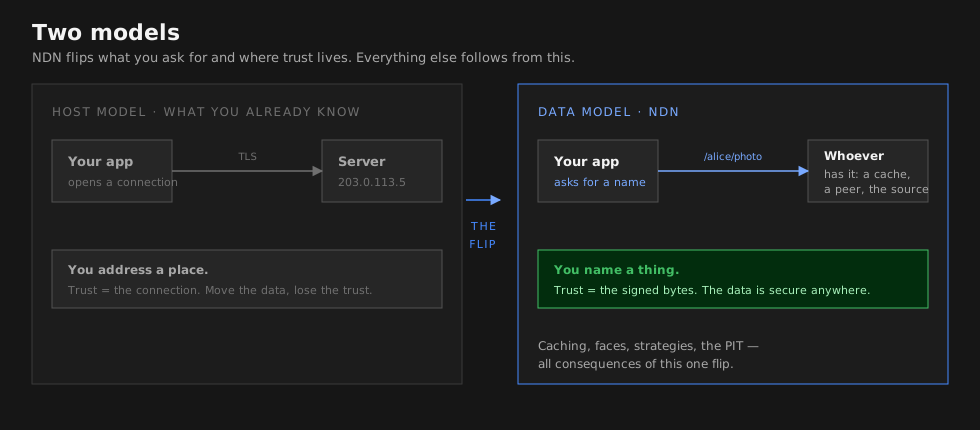
You name a place. A URL resolves to an address; you open a connection to the machine at that address; you trust what comes back because you trust the connection — the TLS certificate proves you are talking to the right server. The data itself is incidental. Copy that same file onto a different server and all of the trust evaporates: new connection, new certificate, prove it again.
This works. It is also why a cache is a special case, why “is this the real file?” collapses into “did I reach the real server?”, and why two people downloading the same thing open two separate connections.
The model NDN uses
NDN names the data, not the place. You ask for /alice/photo. You do
not say where it lives, and you do not care who answers — a nearby cache,
a peer, or the original producer, whichever is closest. What comes back
is a signed packet. You trust it because the bytes carry their own
signature and that signature satisfies a rule you chose — not because of
which connection delivered them.
Everything else follows from the flip
Once data is named and self-securing, the rest of NDN stops looking arbitrary:
- Caching is automatic. Any node that already forwarded
/alice/photocan answer the next request for it. Ten consumers asking for the same name become one fetch and nine cache hits — multicast you get for free, with no special protocol. - There are no connections to manage. A request and its reply are matched by name, not by a socket pinned between two hosts.
- Links are faces, not sockets. A face is an NDN-layer link over whatever bearer you have — UDP, Bluetooth, shared memory, a browser data channel. The data does not change; only the face does.
- Forwarding is a decision, not a fixed route. When a request could go several ways, a strategy chooses. Routing populates the options; the strategy picks among them per packet.
The mechanics behind each of these — the Pending Interest Table, the Forwarding Information Base, the Content Store — are laid out in the NDN overview, and traced through a single request in Interest and Data lifecycle.
Security is the floor, not a feature
Because trust rides with the data, signing and verification are not an add-on you remember to switch on — they are how a packet earns the right to move at all. Every Data packet is signed. A verifier checks the signature against a trust policy that answers one question: is this key allowed to sign this name?
ndn-rs makes this hard to get wrong on purpose. Verified data has a
distinct type — SafeData — and the forwarding path only accepts
SafeData. Unverified data is not “discouraged”; the compiler will not
let you forward it. How keys, certificates, and policies fit together is
in Identity and keys.
What is standard, and what ndn-rs adds
The core of ndn-rs implements published NDN community specifications. On top of that it adds pragmatic engineering — browser transports, in-network compute, network coding, attribute-based encryption — that have no community spec behind them. Those are always marked extension in this wiki, so you are never left guessing whether something is real NDN or specific to ndn-rs. When it matters, the spec-compliance summary records what has actually been verified against the wire format.
Where to go next
You have the one idea. Pick the path that matches why you are here — each assumes the flip above and nothing more.
Still want the mechanics first? Start with the NDN overview.